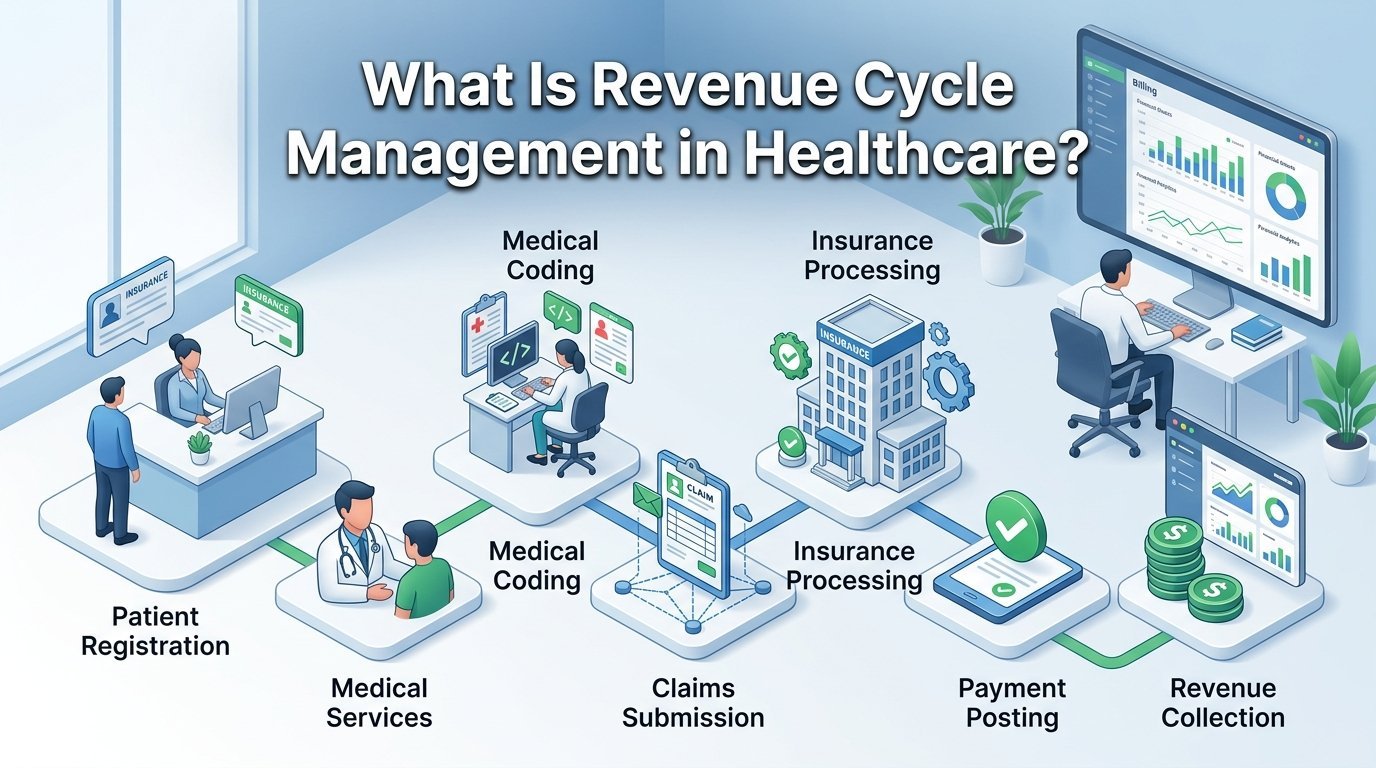
There are a lot of things that can go wrong with billing, but medical practices can be very effective at caring for their patients, and still be in serious financial trouble. A missed eligibility check or coding error, delayed claim or unresolved denial may cause payments to be delayed and put unnecessary strain on practice staff.
But what exactly is medical billing and why is it important?
Medical billing is the act of creating, submitting and tracking healthcare claims for providers to be paid for their services. It is a key component of the healthcare revenue cycle process that links patient care to insurance reimbursement and patient payments.
Healthcare professionals; whether physicians, practice managers, or healthcare administrators; can gain insight into medical billing to spot issues, streamline workflows, and make informed financial decisions for their practice. Practitioners can identify billing issues, minimize unnecessary delays, and optimize financial management within their practice by understanding the medical billing process.
This guide outlines the medical billing process, its key steps, common pitfalls and when it might be wise to hire a medical billing service for a practice.
What Is Medical Billing?
Medical billing refers to the administrative tasks pertaining to the transformation of medical services into claims that are submitted to insurance carriers or billed to clients for payment.
Care is documented when provided. The services are then coded in standardized medical codes and a claim is created. The claim is submitted to the applicable payers, processed, and either paid or denied or sent back for correction.
Medical billing, simply put, serves as an assist for the medical provider to receive payment for medically necessary services rendered to a patient.
This process can be performed through:
- Registration of patients and demographics
- Insurance eligibility verification
- Medical coding
- Charge entry
- Claim application and submission
- Claim status monitoring
- Payment posting
- Denial management
- Accounts receivable follow-up
- Patient billing
- Reporting and reconciliation
Medical billing is closely related to revenue cycle management (RCM). RCM is all about financial processes from patient scheduling to eligibility to receipt of payment, while billing emphasizes submitting and handling charges and claims.
What Is the Significance of Medical Billing for Healthcare Providers?
There are multiple stages involved in the process of reimbursement, which is why healthcare billing is essential.
Patient information errors, missing documents, coding errors, authorization issues and errors by the payers can cause a practice to lose time and delay payment of claims.
A good billing process can assist practices with:
- Making more comprehensive and precise claims
- Gaining insight into billing problems in a timely manner
- Tracking outstanding claims
- Managing denied claims
- Checking unpaid accounts
- Keeping payment records up to date
- Monitoring accounts receivable
- Minimizing administrative burden on clinical staff
- Facilitating more well-rounded revenue cycle processes
Compliance is another aspect that needs attention when it comes to medical billing. Coding and claims must accurately reflect the documentation of services in the patient’s medical record. Practices need to remain diligent on the applicable payer requirements and billing rules.
It’s not just about sending more claims. The objective is to submit accurate claims and to deal with them appropriately in a timely fashion before the claim is denied due to problems.
What Is the Medical Billing Process?
A medical billing process is quite a complex affair.
There are various stages to the medical billing process. The process of workflows typically is as follows but can differ, depending on specialty, payer, and practice.
1. Patient Registration
The process starts with the patient’s demographic and insurance data.
The practice gathers information like a patient’s name, date of birth, address, insurance details, and so on. Registration information is crucial as there can be an issue if there is any mis-registration in the information in the future when eligibility is being checked or claims processed.
2. Insurance Eligibility Verification
The practice checks a patient’s insurance status prior to or at the same time of the appointment.
Eligibility verification can be used to verify eligibility information and to determine potential patient responsibility. In addition, due to the service, the practice may also need to identify if there are authorization requirements or other payer requirements.
Identifying coverage problems prior to delivery of services can minimize unnecessary billing problems.
3. Medical Coding
Once the patient has been cared for, documentation is checked and the services translated into standard codes.
These are the common coding systems used in U.S. healthcare:
- Some medical procedures and services have CPT codes.
- The ICD-10-CM diagnosis codes are used for diagnoses.
- HCPCS codes are used for some services, supplies and procedures.
It is important to code accurately since the codes on a claim tell what happened and why the service is being rendered.
The provider’s documentation and applicable coding requirements should support coding.
4. Create and Prepare Claims for Charges
Coded services and patient information is inputted to the billing system. This claim is then ready to be created with relevant information for submission.
The claim may be reviewed by billing staff prior to submission for missing or inconsistent information. This is a critical step as it may be easier to fix errors prior to submission than to deal with a denial afterwards.
5. Claim Submission
The completed claim is submitted to the insurance payer.
The payer is the responsible party for the patient’s coverage, which can be from Medicare, Medicaid, a commercial insurance provider, or another responsible party.
It is often utilized for electronic claim submission, since the claims are able to flow through the billing process efficiently. But electronic submission does not negate the need for careful review.
6. Claim Processing
The claim is looked at by the payer and a decision is made on how to process the claim.
The claim may be:
- Paid
- Partially paid
- Denied
- Refused or returned for correction
- On hold — further information required
An “X” in the “REJECTED” column does not mean a “DENIED” in the “DENIED” column. A rejected claim will not pass the initial claim submission or data validation tests, while a denied claim will be submitted by the payer but not approved to be paid.
7. Payment Posting
Payment received is to be properly posted to the patient’s account.
Payment posting includes posting insurance, adjustments, contractual amounts and the patient’s responsibility. Posting accurately is important for the practice to keep the correct balance in accounts and to know the correct amount that remains to be collected.
8. Denial Management and AR Follow-Up
All claims do not receive immediate payment.
Billing teams delve into why claims were denied, determine the best next step and follow up with the payer as needed when the claims go unpaid.
In a sense, accounts receivable (AR) follow-up is an even more crucial activity for older outstanding accounts. If these claims are not followed up consistently, the unpaid claim can remain unpaid and put further cash strain on the practice.
9. Patient Billing
Following the processing of insurance, the patient may then be responsible for any remaining amount that is not covered by insurance.
The quantity may rely on the patient’s insurance benefits, deductible, copayment, coinsurance, and other factors that might be relevant.
This is another crucial step in the revenue cycle – the collection of the patient’s share of the payment.

What Are the Typical Medical Billing Issues?
Billing issues can occur in an even well-organized practice. The following are some of the most frequent problems:
Eligibility and Insurance Coverage Mistakes
If incorrect information is provided on the insurance or coverage is not active, it can cause problems with claims and patient bills.
Coding Errors
Faulty, incomplete or unsupported coding can lead to rejected or denied claims and present compliance issues.
Missing Prior Authorization
The service may need to be preauthorized according to the rules of the payer. Failure to grant permission can lead to a delay or denial of reimbursement.
Claim Denials
There may be numerous reasons for denials, such as eligibility, coding, authorization requirements, missing information and/or rules for payers.
Slow AR Follow-Up
Claims are best attended to in a timely fashion. If accounts are not continually reviewed and followed up, payments may take longer to be resolved.
Payment Posting Problems
Inaccurate or late posting of payments can result in incorrect account balances and make it more difficult to know what is outstanding.
Changing Payer Requirements
All insurance policies, payer processes and billing requirements can change. Practices must have suitable processes in place to manage these requirements, and to adjust their processes as needed.
What Are the Best Ways for Medical Practices to Improve Their Billing Process?
While the billing process can be transformed in some practices, it doesn’t have to be in all practices. In many cases, improved outcomes start with improved processes and follow-up.
Check Insurance Information Up Front
Include eligibility verification as part of routine processes. Proactive identification of coverage issues prior to or in conjunction with service delivery can limit preventable coverage billing issues.
Review Claims Before Submission
Prior to submission, review claims to ensure they have been considered.
A straightforward claim review can detect missing demographic data, coding problems, authorization issues or other issues before the claim even reaches the payer.
Monitor Denials
Don’t assume that denials happen once and are never repeated. Monitor the reasons for denials and identify trends. If the same problem keeps recurring, the problem might be a workflow issue and should be resolved at its root.
Consistently Follow Up on ARs
If an account is outstanding, it should be reviewed in accordance with the proper internal priorities. Regular follow-up will prevent unpaid claims from becoming lost.
Ensure Coding and Billing Teams Are Aligned
The relationship between clinical documentation, coding and billing is intertwined. There is a strong benefit for clear communications among these functions in identifying problems as early as possible and ensuring proper claims are filed.
Review Billing Data and Identify Problems
Reports can provide information to the practice manager on various topics like claim status, denial patterns, outstanding AR, payment activity, etc. It is important to review this information on a regular basis to assist with making better operational decisions.
When Should You Use a Professional Medical Billing Service?
Billing internally can work well for some practices, but can become challenging as the number of patients, complexity of payers and administrative tasks grow.
Professional medical billing services can be considered by a practice when:
- Billing staff are deluged.
- Claims are not consistently followed up.
- Denials are increasing.
- AR is getting hard to control.
- Information for eligibility verification is inconsistent.
- The posting of payments is delayed.
- Practice leaders don’t have visibility of billing performance.
- Administrative duties are removing staff from other essential work functions.
The provider remains responsible for proper documentation, coding and compliance even if there is an outsourcing agreement in place. Rather, a professional billing partner can offer extra operational assistance to the right segments of the revenue cycle.
When your practice is spending too much time dealing with claims, billings, or unpaid invoices, Noventra RCM can offer a professional medical billing and RCM service to meet your practice’s needs.
How Are Medical Billing and Revenue Cycle Management Different?
Though medical billing and medical revenue cycle management are related, they are not synonymous.
The core of medical billing is dedicated to the financial aspect of billing, which entails the generation, submission, monitoring, and settlement of claims and patient balances.
RCM encompasses a wider array of activities throughout the healthcare financial lifecycle.
RCM may include:
- Patient registration
- Insurance verification
- Eligibility verification
- Prior authorization support
- Medical coding
- Charge capture
- Claim submission
- Denial management
- Payment posting
- AR follow-up
- Patient billing
- Revenue cycle reporting
Effective billing is one component of a comprehensive revenue cycle in practice.
What Can Be Done With the Help of Professional RCM Support?
Healthcare providers should have the opportunity to focus on patient care without the administrative burden of billing.
An RCM partner can assist with the right areas of the revenue cycle, such as:
- Billing
- Claims management
- Coding
- Eligibility checking
- Denial management
- Payment posting
- AR follow-up
Professional support is more than just handing over tasks. It’s also related to establishing a more uniform way of handling the financial aspect of healthcare operations.
Novenetra RCM offers expert medical billing and healthcare RCM solutions, tailored to meet the medical billing and revenue cycle needs of healthcare providers.
Wrap-Up: The Importance of Medical Billing
Everyone in the healthcare industry needs to have a medical billing definition in their hands as it is a crucial link between patient care and payment.
Registration, eligibility verification, coding, claim submission, payment posting, denial management, and AR follow-up are just a handful of the steps that can impact a medical practice’s financial results and administrative effectiveness.
In summary, the best medical billing is characterized by the use of proper information, correct coding, timely claim submission and processing, follow-up, and respect for payers’ needs.
Professional support can also help supplement the workflow and revenue cycle management capabilities of practices facing challenges. With Noventra RCM providing healthcare providers with professional medical billing and RCM solutions, practice teams can focus more of their time on their core responsibilities.