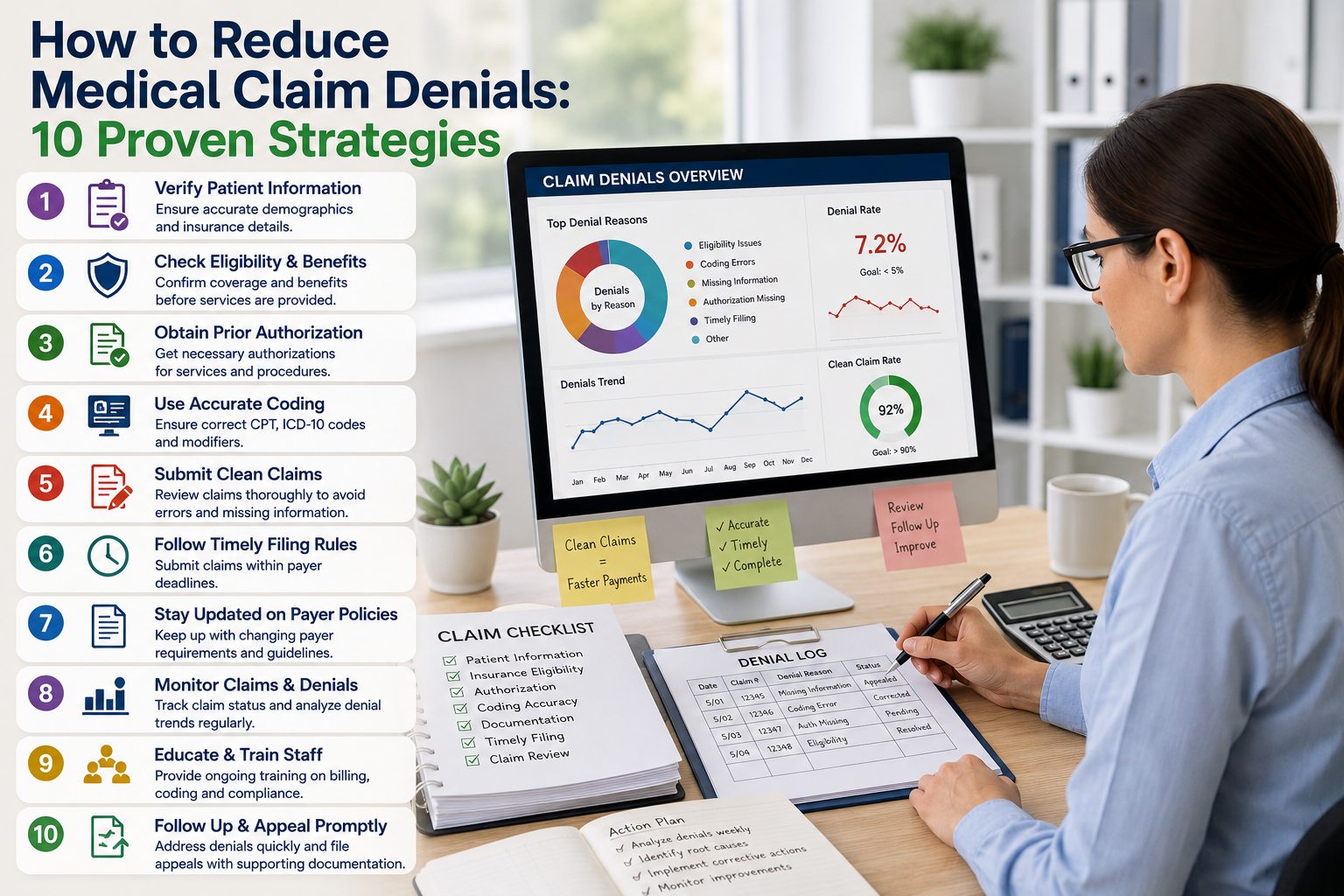
Denials of claims can be a major issue for healthcare practices in a matter of time. Claim denial can be due to patient information, coding errors, no authorization, eligibility, or special payer requirements. These issues can hold up reimbursements, add to administrative burdens and strain practice cash flow when they reoccur.
Fortunately, many denials can be avoided before a claim reaches the payer. Revenue cycle management is based on four elements: Accurate patient information, insurance verification, coding, and claim submission, and follow-up.
The two main points for practices seeking to minimize medical claim denials is to be proactive versus reactive in addressing medical claim denials, as well as ensure that denials are not treated as a problem that needs to be solved once the claim is denied.
Here are 10 practical tips for claim denial prevention, the most common reasons for medical billing denials and how healthcare organizations can improve their denial management workflow.
What is a Medical Claim Denial?
A medical claim denial is when the insurance payer denies a claim in full or in part. The payer can decide that the claim is not payable or that it is missing further information, corrections, or documentation.
A denial is a different thing to a claim rejection. The usual reason for a rejection is before the claim was fully processed and was due to a mistake that prevented it from being adjudicated. A denial of the claim usually happens after the claim has been sent to the payer and the payer has decided that the claim will not be paid as it was submitted.
Some of the most frequent reasons for medical claims to be rejected are:
The patient’s or patient’s insurance information is entered incorrectly.
Inactive insurance coverage
No medical codes or codes provided that are missing or incorrect.
Not having a pre-existing authorization.
Services that are not covered
Duplicate claims
Missing documentation
Incorrect modifiers
Timely filing issues
Coordination-of-benefits problems
Medical necessity concerns
A claim or bill is missing or is incorrect.
It is important to know why a particular denial is made so it can be avoided in the future.
What’s the reason for minimizing medical claim denials?
Claim denials have an impact beyond just the delayed claims. There are many revenue cycle areas that can be impacted by a high denial volume.
If staff is spending time repeatedly investigating, correcting, resubmitting, and appealing claims, then it’s taking less time to do the job’s other important billing activities. Unresolved denials can also lead to higher A/R and the inability for practice leaders to know what the actual financial situation is.
To help practices:Practices can help by:
Make claim submissions more accurate.
Minimize unnecessary billing rework
Help get reimbursements on time
Take steps to improve Accounts Receivable management.Increase the efficiency of Accounts Receivable.
Recognize common billing issues and resolve them.
Reduce administrative burden
Improve revenue cycle processes.
Adopt methods to enhance communication between clinical and billing staff.
The aim isn’t just to work denials quicker. The aim is to find out why they occur and avoid them again.
Here are 10 proven strategies to help minimize medical claim denials.
2. Check Patient Eligibility prior to the Appointment
One of the major reasons for avoidable billing problems is insurance eligibility issues.
An insurance policy may change due to a new employer, plan termination, plan changes or other reasons. If a patient’s insurance information is still active, but they change which plan they have, claims may be submitted to the old plan.
At all possible times, practices should check for eligibility status prior to offering services. The process should verify key data to include:
Active coverage
Member identification
Group information
Coverage dates
Patient responsibility
Benefit details
The primary versus secondary coverage issue.The issue of primary and secondary coverage.
Relevant plan limitations
Eligibility verification provides a chance for the practice to determine issues that may exist before the claim is even filed.
If practices don’t have as much time and staff to dedicate to administrative work, professional insurance verification support can help streamline this process, and eliminate unwanted billing mistakes.
Ensure that the prior authorization requirements are met.
There are services that need to be authorized in advance in order to be carried out. Even if the service is medically appropriate, the payer may refuse to pay the claim if authorization was needed but not completed.
Authorizations may differ depending on patient situation, service, plan and/or payer. It is also important that practices not presume coverage when it is applied to another patient or to a patient under another insurance plan.
Prior to scheduling and/or conducting a service that might need authorization, staff should check on the applicable requirements of the payer and record the information related to the authorization in an appropriate manner.
The workflow should also link authorization details to the patient’s appointment and billing record so that the billing team can refer to this when submitting claims.
Inconsistency in authorization management can create issues with even valid claims that were correctly coded.
3. Enhance the accuracy of medical coding.
Medical coding plays a crucial role in the success of claims submissions. Denials, delayed reimbursement, and requests for more information are possible consequences of incorrect coding.Denials, delayed reimbursement, and requests for more information are possible consequences of incorrect coding.
Some common coding errors can be:
Incorrect diagnosis codes
Incorrect procedure codes
Missing modifiers
Inappropriate modifiers
Any coding that is not matched with the documentation.
Information about a claim that is incomplete or inaccurate.
Incorrect diagnosis or procedure information.
Medical coders need to scrutinize all documentation and use the appropriate codes for the services rendered and based on coding guidelines.
Use a Strong Clean-Claim Review Process (SCCPR)
A clean claim is a claim that has all necessary information so the payer can process it without unnecessary corrections, or further requests.
Practices should make sure they review key data elements before they submit claims such as:
Patient demographics
Insurance information
Provider information
Diagnosis codes
Procedure codes
Modifiers
Place of service
Authorization information
Dates of service
Claim filing requirements
Some of the errors in claims can be pinpointed before they are sent to the payer through an effective claim-scrubbing process.
Denial Management is an important element of this since a denial is typically the most efficient way to prevent an error before it’s submitted, than to correct it after it is adjudicated.

5. Ensure the accuracy of Patient and Insurance Information
The small demographical mistakes can cause gigantic billing problems.
If the patient’s name is misspelled, the date of birth is incorrect, the member ID is wrong or the insurance information is outdated, the claims will not match with the member, and the payer will not be able to process the claim.
The front desk and registration personnel are critical in the claim denial prevention process. Patient information should be reviewed frequently particularly if the patient notifies the provider of an insurance or personal change.
Practices can also put in place a consistent registration process so that they are able to gather the information required by the billing staff.
The starting point of the revenue cycle is important and essential for building a solid foundation for the rest of the cycle.
6. File claims in time with the payers’ filing deadline
Timely filing of medical bills is another essential aspect of medical billing.
Deadlines for claims may be set by payers. The claim may be denied for reimbursement even if the service was otherwise eligible for reimbursement, when submitted after the applicable filing period.
To minimize potential problems of timely filing, practices should monitor:
Dates of service
Claim submission dates
Payer-specific filing requirements
Corrected claim deadlines
Appeal deadlines
Pending claims
Claims should be made promptly following verification of the information as soon as practicable.
A uniform billing process will reduce the amount of claims that sit in work queue unnecessarily.
7. Do not address each denial individually; track the trends of denials.
A very helpful method to denial management is to review denials in a group.
Suppose, for instance, that 50 denials are received in a month at a practice. If the billing team views each denial as an individual claim, they can fix 50 claims without resolving the problem.
Rather, the practice has the ability to classify denials by reason, payer, provider, procedure, location or workflow phase.
These are typical categories that can be:
Eligibility denials
Authorization denials
Coding denials
Medical necessity denials
Duplicate claim denials
Timely filing denials
Documentation-related denials
Patterns can identify points in the revenue cycle where things are going wrong.
If a lot of denials are related to the same problem, staff training, changes in processes, verification or documentation improvements can alleviate the problem at its source.
This makes denial management a process of continuous improvement instead of a reactive one.
8. Create a consistent Denial Follow-up Process
Despite a strong prevention programme, a certain number of claims will be denied. There are unavoidable Billing challenges such as insurance policies, documentation requirements, Coding questions etc.
Consistency is the key.
A follow-up process for denial should seek to determine:
The reasons of denial.
The correctness of the denial.
The information or correction which is required.
Whether it may be corrected, resubmitted and/or appealed.
What deadline applies.
Whether the underlying issue would impact other claims.
Staff should make follow up actions and be visible of unresolved claims.
Claims can languish in accounts receivable for extended periods of time without a process, which can reduce the chance to appeal or file claims in a timely manner.
9. Improve communication between clinical and billing staff.
Claim problems don’t always occur within the billing department.
Any missing detail in the diagnosis, missing documentation, procedure details that are incorrect, or inability to communicate an authorization problem could start earlier in the revenue cycle.
That is why there needs to be a clear process in place for billing teams to communicate with providers and clinical staff about recurring claims.
For instance, if the documentation-related denials consistently occur in a specific type of service, the billing team can uncover the trend and engage the relevant employee(s) to address the issue of documentation.
Similarly, if some procedures often need authorisation, the scheduling and clinical teams should be aware of the procedure, and what the workflow should be.
Improved communication links the clinical with the financial aspects of healthcare revenue cycle.
10. Use Key Performance Indicators to Measure Denial Performance
What you can’t measure, you can’t improve.
Healthcare medical practices should track relevant revenue cycle key performance indicators to determine if denial prevention activities are successful.
Some of the measurements that can be useful are:
Overall claim denial rate
Denial volume
Denial reasons
Denials by payer
Denials by provider
Denials by procedure
The number of days taken to collect overdue payments.
Appeal volume
Appeal outcomes
The amount of time it takes to settle denials.The time needed to settle denials.
The percentage of denials that are repeat denials.Percent of repeat denials.
These metrics aren’t tracked just for the sake of reporting. The information should be used to make operational decisions.
If, for instance, one denial category consistently goes up, then practice leadership can review the reasons for the change by asking whether the requirements for the payers has changed, the workflow of staff has changed, coding has changed, or documentation has changed.
Being proactive in billing practices is achieved with regular review.
When is the best time for a Medical Practice to consider Professional Denial Management?
A practice needs extra denial management resources when staff are regularly handling:
Growing accounts receivable
Many unpaid or denied claims in large quantities
Repeated denial reasons
Missed follow-up deadlines
Complex payer requirements
Limited billing staff
Inconsistent claim follow-up
Problems determining the underlying reason behind the denial(s)
Administrative workloads that take staff away from other responsibilities
Professional assistance may be especially beneficial for a practice that is looking to build a more formalized revenue cycle process, but doesn’t want to bring on a large number of administrative staff members.
Noventra RCM can assist healthcare providers with medical-related billing and RCM services and make it easier for practices to master vital aspects of the billing process, such as claims management, denial management, coding, eligibility verification, and AR follow-up.

The Key to Long-Term Claim Denial Prevention
Denial reduction is an ongoing project. It is a continuous process in the revenue cycle.
Best approach is prevention, measurement and follow-up. Practices should ensure insurance is obtained before services, check authorization needs, keep accurate patient information, accurately process medical coding, review claims prior to submission, track claims deadlines, and analyze trends of claim denials.
If denials do arise, it’s not just about fixing a single claim, it’s about the entire claim. Practice leaders need to ask why the denial has occurred and if there may have been other claims in the practice that are at risk.
This attitude is the key to proactive denial management as a revenue cycle management component.
Discussion: Develop a Tighter Process to Decrease Medical Claim Denials
The time spent in denial can be costly for staff, result in delayed reimbursement, add to the accounts receivable, and the administrative burden is wasteful. But there are a number of denied claims that can be avoided by improving the pre-claim and post-claim processes.
Healthcare practices need to concentrate on medical claims accuracy, medical coding, clean-claim review, patient data accuracy, timely filing, denial trend analysis, consistent follow up, cross-team communication, and performance measurement to minimise medical claims denials.
The key to learning from denials is simple: don’t see each denial event as a one-off billing issue. Find patterns, determine causes and enhance the process used to cause the problem.
Noventra RCM provides professional medical billing & RCM solutions for practices with additional support needs that are applicable to claims management, coding, eligibility, denial management, AR follow-up, and other critical billing activities.
A better revenue cycle starts with a uniform process for avoiding unnecessary issues that could lead to expensive denials.