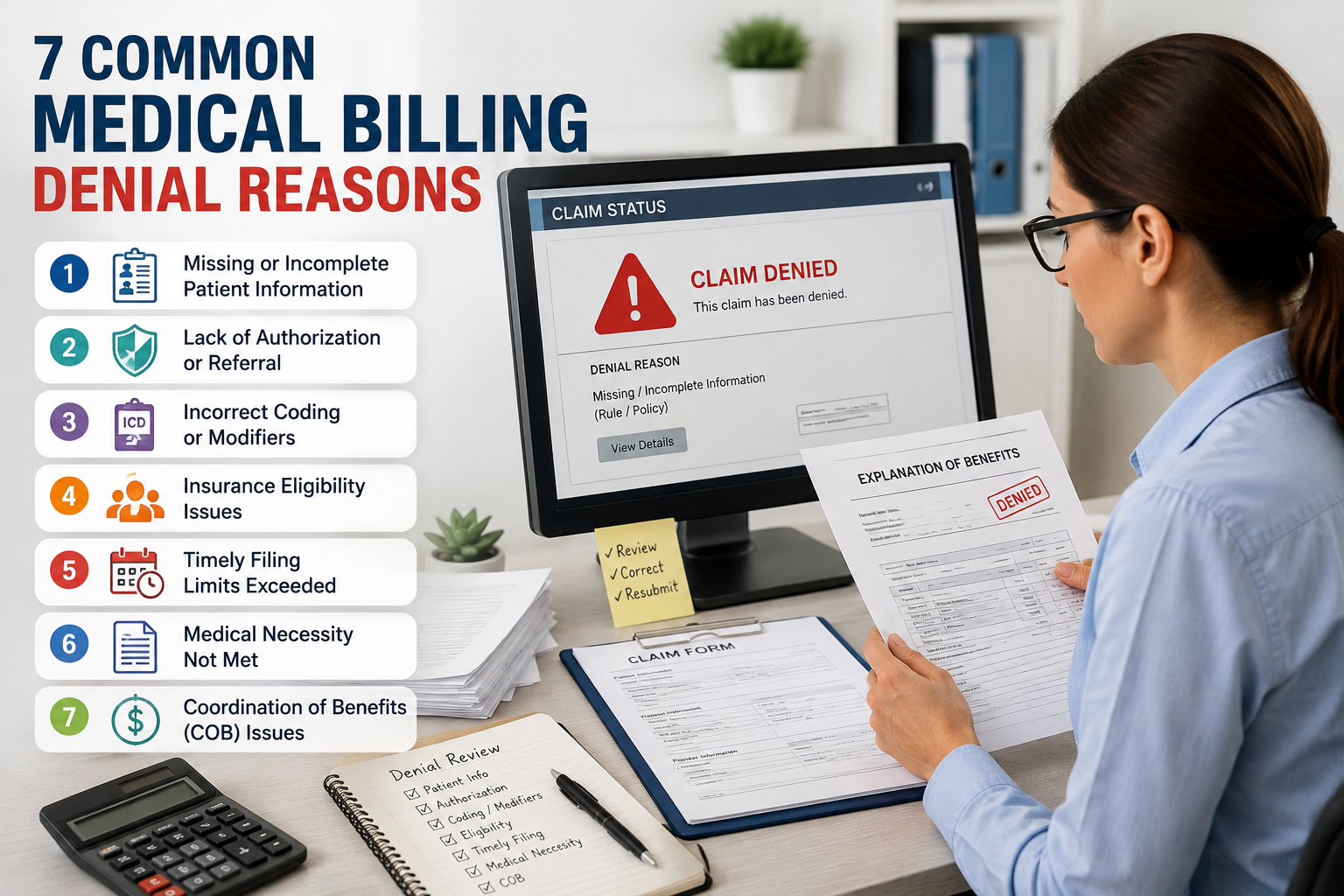
Denials of medical claims can escalate back into a big problem for healthcare practices’ revenue cycles within no time. The denial can be for a variety of reasons, such as an eligibility question, coding mistake, lack of authorization, incorrect patient information or a payer-specific reason. A denial, even if correctable, can cause further work to occur, which can cause a delay in reimbursement and add to administrative costs.
By knowing the top medical billing denial causes, providers can preemptively address the issues before claims are denied. Avoidable billing issues can be minimized by having strong front-end processes, accurate coding, timely claims, and consistent claim denials.
Denial Prevention isn’t just about rectifying denied claims for physicians, practice managers, and billing teams. It’s a matter of determining the root of the problem and optimizing the revenue cycle so it doesn’t happen again.
We’ll look at seven of the most common claim denial causes, how they occur, and what medical practices can do to avoid them. We’ll also cover how Noventra RCM can assist providers with the medical billing and revenue cycle management.
What Is Medical Billing Denials?
A medical billing denial is when a claim is filed and the insurance payer denies to pay the claim, either partially or in full. Typically, the reason or denial code is given by the payer, detailing why the payment was not accepted.
Denied claim is not a rejected claim. Most likely, a rejection will happen before the claim is completed due to a data or submission issue. A denial typically indicates that the claim has been received by the payer for adjudication, but failed to meet the payment criteria of the payer.
Denial problems may include:
Patient eligibility
Medical coding
Missing or incorrect information
Prior authorization
Timely filing
Duplicate claims
Coverage limitations
Documentation requirements
Coordination of benefits
Payer-specific billing rules
Frequent denials can lead to higher accounts receivable, cash flow problems and time spent by staff.
Why Medical Billing Denials are Important?
A refused claim might appear to be a minor administrative problem. But, the more times you deny a claim, the bigger the revenue cycle hurdle becomes.
Billing staff might need to review the payer’s response, determine the problem, correct the claim, get the supporting documentation, send a claim for appeal, resubmit a claim, and follow-up again. This process consumes time that may be better spent on clean claim submission, patient accounts or other practice activities.
When there are frequent denials, there could be a problem with the revenue cycle in general.
For instance, if there are a lot of denials, this may indicate that the prior authorization process is broken. Multiple eligibility denials might show that insurance verification is not taking place in a timely and regular manner. If coding-related denials are detected, it indicates that the claim is in need of further review prior to submitting it.
Denial prevention isn’t just about getting unpaid claims back, though. It is to identify patterns and to solve the root cause problem.
The top 7 medical billing denial reasons are listed below:
A. Patient Eligibility & Insurance Coverage Issues
One of the most frequent causes for medical billing denials is due to wrong or inactive insurance policies.
A patient may have enrolled in different insurance plans or lost coverage, had exhausted benefits or have given incorrect insurance information. However, there are other times when the practice is a different member ID, a different group number, or a different payer information.
A patient makes an appointment with the insurance card that is still valid, but was issued several months ago. Patient’s employer has since switched insurance plans. The denial is due to the fact that the coverage is inactive or the claim was submitted to the wrong payer if the practice submits the claim with the old information.
How to avoid any denials based on eligibility.
These issues can be addressed by medical practices by making eligibility verification a front-end revenue cycle process.
Best practices include:
Ensure insurance eligibility prior to scheduled services, as appropriate.
Confirm the patient’s member ID and group information.
Look for any changes in the Payer information.
Check coverage for the service, if needed.
Ensure that patient information and insurance is kept current.
Create procedure to address discrepancies of eligibility prior to billing.
For practices that have many patients with different insurance plans or who have patients who frequently change their insurance, verification of eligibility is critical.
2. Incorrect Medical Coding
Other common causes of claim issues are coding errors. Accurate CPT, ICD-10-CM and HCPCS coding is the foundation of medical claims, which convey services rendered and medical conditions or circumstances that justify the services.
Codes can cause a claim to be payment deficient if they are incorrect, incomplete, inconsistent with documentation or reported incorrectly.
A procedure code, for instance, could be different from what is documented in the medical record. In other cases, the diagnosis code may not be appropriate based on the service in the context of the provider’s billing policy.
Modifiers, units, code combinations, and other claim details can also be a source of coding errors.
Learn how to avoid coding denials.
Practices should have a uniform coding review procedure which takes into account the following:
Provider documentation
CPT coding
ICD-10-CM diagnosis coding
When applicable, include HCPCS codes.
Modifiers
Units and quantities
Payer-specific requirements
Correct code combinations
However, medical coders and billing personnel should also remain up-to-date with coding guidelines and payer regulations.
If coding denials are occurring repeatedly, then looking back at the denial trends can provide information to make decisions on whether more coding education or pre-bill review is necessary.
3. No or improper Prior Authorization
Other payers may require prior authorization or some other approval for services to be delivered. If authorization is needed but not received, a resulting claim might be disallowed.
This is often difficult to manage when authorization is needed for different payers, plans, services, procedures, and/or patient coverage.
One is, for instance, the technique of performing a procedure without ensuring the patient’s insurance plan is for that service. The provider carries out the service, and the claim is denied after the necessary approval is missing.
How to avoid getting the “authorization denied” error message.
An effective authorization flow should start before the service is rendered.
Medical practices can:
Confirm patient’s existing insurance.
Decide if the planned service needs authorization.
Provide authorization request if required.
Note authorization number and approved service information.
Ensure that the approved service will be in accordance with the procedure.
Keep track of authorization dates and limits.
Define authorization needs with staff in a clear and easy to understand way.
Authorization details should be captured and available to the billing team prior to submitting the claim.
Noventra RCM can offer your practice a variety of medical billing and RCM services that are applicable to the authorization and claim process, which can help your team run revenue cycle workflows more efficiently.

4. The information in the claim is missing, inaccurate or inconsistent with the application of the claim.
There may be issues with billing due to minor data inaccuracies. There are numerous fields on a claim that could have inappropriate information on them which may impact the payer in processing it.
Potential problems include:
Incorrect patient name
Wrong date of birth
Incorrect member ID
Incorrect payer information
Missing provider information
Wrong billing or service location
Incorrect NPI information
Missing claim details
Ambiguities in the information provided on the claim.
For instance, if the patient’s member ID is not entered correctly in the system, the payer may not be able to locate the claim in the patient’s insurance.
What’s the solution to “data denials”?
Best way to fix errors is to identify and correct them before they get to the payer.
If appropriate, the following processes should be used: front-end verification, claim scrubbing and pre-submission review. Staff should also have established protocols to update information about a patient’s demographics and insurance information.
An accurate claim process begins with an accurate registration and extends to coding, billing and submission.
5. Timely Filing Denials
Typically, insurance companies set deadlines for policies. The claim may be denied due to not being timely filed if it is submitted after the applicable filing deadline.
The exact date of the transition may depend on the payer, plan, contract, and/or situation. Each Medicare, Medicaid and commercial insurance program may have its own criteria.
Problems may arise in filing timely, due to:
Delayed claim submission
Missing information
Unresolved claim rejections
System issues
Incorrect payer routing
Delayed documentation
The failure to monitor rejected claims is a problem.Problem with failure to monitor rejected claims.
What to do to avoid “timely filing denials”
Medical practices need to track submitted claims from the time of submission through adjudication, not assuming that all submitted claims will be completed.
Useful practices include:
Return claims promptly and clean.
Track reports of claims acceptance and rejection.
Claims for work rejected were acted on promptly.
Follow up on outstanding claims.
Maintain payer-specific filing requirements.
Check accounts for aging periodically.
Take cases up the chain before deadlines arise.
Good claim management happens to be an essential element of effective accounts receivable management.
6. Duplicate Claims
It is possible for a duplicate claim denial to occur if the claim is filed multiple times with a substantially similar claim.
If a claim is accidentally resubmitted, there are issues with the system, the claim is unclear who owns it, or two employees are submitting the same claim, duplicates may result.
If all they do is repeat the submission, then it does not necessarily speed up the payment. Rather, they may lead to the development of extra administrative burdens and claim tracking complexities.
Preventing duplicate claims to be denied.
Staff billing should ensure that the billing status is verified before re-submitting a claim.
The following is a good workflow:
Verify if the initial claim is accepted.
Review the status of payers’ claims as appropriate.
Review clearinghouse reports.
Identify rejection or denial of a claim.
Solve the original problem if possible.
Record claim activity in the proper billing system.
Having a clear understanding of outstanding claims can also help minimize the chance of duplicate work among billing team members.
7. Medical Necessity and Documentation Issues
Pays may refused claims when the service submitted is not covered or is not medically necessary or when documentation does not substantiate the claim.
Medical necessity is tightly linked to the patient’s diagnosis, the kind of service received, medical documentation and the applicable medical policies of the payer.
For instance, it could be necessary to show how a certain service was suitable for the patient. Payment may be denied if the documentation does not meet the requirements for the service or the diagnosis submitted is not sufficiently supported by the documentation.
Tips on avoiding medical necessity denials
Accurate and complete documentation is key for both provider and billing team.
Practices can:
Ensure that services provided will be documented clinically.
Use appropriate diagnosis codes based on the medical record.
When appropriate, check payer coverage before services are rendered.
Make sure that the code submitted is correct to the documentation of the service.
Ensure necessary paperwork is available prior to claiming.
Review any recurring medical necessity denials to see if there are patterns.
Documentation is important to ensure proper coding as well as claims management.
What steps can medical practices take to boost denials prevention?
Knowing what to expect in terms of denials is just the beginning. Working towards creating a repeatable process for preventing them is the next step.
The following are some examples of a practical denial prevention strategy:
1. Strengthen Front-End Processes
Issues with billing often start before a claim is created. Prevention of avoidable problems later can be achieved through eligibility verification, accurate registration, insurance verification and authorization checks.
3. Review the CodeHistory File
Coding accuracy is directly related to claim processing. Coding controls and review practices should be appropriate for practices based on specialty, payer mix and the number of claims submitted.
3. Monitor Denial Trends
Don’t see “denials” as one-offs. Organize them into categories by reason, payer, provider, procedure, location, etc.
An example of this is that when a practice receives multiple authorization denials from one or more payers, they can look at the payers’ requirements and make the authorization process more efficient.
Track Rejections and Denials separately.
There are different workflows for rejected claims and denied claims. Tracking both enables billing teams to spot issues as soon as possible and prevent delays.
The following checklist highlights steps that can be taken to prevent simple denial.
Billing teams can check these important areas before filing a medical claim:
Patient information accuracy: Does the patient’s demographic information agree with the patient’s?
Do you have insurance and if so, does it accurately identify you?
Authorisation: Was authorisation needed and received?
Are there coding discrepancies between CPT, ICD-10-CM and HCPCS codes and the documentation?
Documentation: Is medical record sufficient to support services billed?
Claim information – Is provider, payer, location etc. correct?
Timely filing: Is the claim filed within the time limits?
Claimed status: Has this claim been submitted or processed?
Many of the issues that will be denied can be spotted through a regular pre-bill review process.
Novenitra RCM can assist with denial prevention in a variety of ways.
Denial Prevention is more than a denial correction. It needs to be addressed throughout the whole revenue cycle, from insurance verification and coding, all the way to the claim submission and AR follow-up.
Novenitra RCM is a professional medical billing and revenue cycle management services provider to healthcare service providers. Services could be medical billing, medical coding, claims management, denial management, insurance verification, and AR follow-up.
Professional RCM support could be another tool to manage such workflows if your billing team is devoting too much time to claim corrections that are avoidable. Noventra RCM may be your partner for billing and RCM depending on your medical practice’s requirements.
Final Thoughts
It’s crucial to be aware of the typical medical billing denials and understand the rationale behind them. Issues of eligibility, coding, missing authorizations, documentation, medical necessity, medical documentation, timely filing, duplicate filing and medical necessity or documentation problems can all interfere with reimbursement.
The focus should be to shift the discussion away from single denials. Practices should be alert to, and follow up on, denial patterns, enhance front-end practices, accurately code claims, verify authorization practices, submit clean claims timely, and follow up AR processes.
If you’re experiencing continuous billing denials or a shortage of in-house billing team members, having professional RCM support can help you keep all key revenue cycle processes organized and in hand.
Noventra RCM can offer medical billing and RCM services customized to the needs of medical practices. If your practice is spending valuable time on claim denials, it may be a good idea to consider professional billing support services.